Channel protocol
What travels between the broker and a worker, and the sequences that use it. Read Architecture first for the shape this sits inside.
The wire
Section titled “The wire”Messages are final readonly PHP objects in Ipc\Message. Each one crosses
the amphp/parallel channel as one JSON frame:
{"t": "subscribe", "m": {"subscription_id": "w0:3", "app_id": "demo", "kind": "event", "selector": {"kind": "exact", "value": "zha_event"}}}t is the tag IpcCodec::TAGS assigns to the message class it
carries. m is the message as WireMapper writes it. Each key is the
snake_case of a constructor property, and instants and durations are integer
microseconds under a _us key (lost_at_us, grace_us). IpcCodec refuses a
message class that has no tag. ProcessContext still wraps each frame string in
serialize(), because it hard-wires NativeSerializer. What reaches
serialize() is a string, never an object graph.
State is encoded once for every worker.
StateSnapshot, StateResynced and StateChangeBatch hold EntityStatesFragment and
StateChangesFragment fragments, which cache their JSON on the broker. The frame
splices that JSON in unescaped. On the worker, the same classes hold the decoded
lists.
The vocabulary belongs to the wire. A message may use only contracts, the
Runtime\Model enums and DTOs, and Ipc types such as WorkerApp,
WorkerSettings and StoreSettings. A phpat rule enforces
this, so changing a config value object is never a protocol change.
The rules that follow:
Bootstrapcarries the protocol version. A worker whoseIpcCodec::PROTOCOL_VERSIONdiffers stops withTransportError::ProtocolMismatchbefore it reads anything else. Any change to a message’s shape bumps it; the IPC goldens fail until it does.- A frame that cannot be decoded is dropped. The reader logs its tag and
carries on. An undecodable
Bootstrapstops the worker. - Selectors are one closed type.
Selectoris a final value object whose kind is exact, glob, regex or any-of, and*crosses asany. A string becomes a glob when it has*or?, and an exact match otherwise; a regex is only ever built withSelector::regex(). - Payloads must be JSON. Topic payloads refuse objects and non-finite
floats up front. Service data that cannot be encoded fails the call as
Rejected. - Log context is flattened before it is sent, and a
Throwableis never sent as itself.AppFailedcarries a flattened trace and theExceptionDetailsof a Stewart exception:{class, reason, context}, with the reason as its enum value.
Sends are drained one at a time in a single fiber per worker. That is what keeps channel writes ordered and stops a large snapshot interleaving with the events queued behind it.
The Ping/Pong loop-lag figure assumes both processes share a clock —
true because they are the same host by construction. The delay between the
broker stamping a ping and the worker answering is then a usable proxy for how
backed up that worker’s event loop is.
The message set
Section titled “The message set”
Forty-one messages, closed by the BrokerMessage, CorrelatedReply and
WorkerMessage marker interfaces and by the IpcCodec::TAGS tags.
Broker → Worker
Section titled “Broker → Worker”| Message | Purpose |
|---|---|
Bootstrap |
The protocol version, identity, timezone, Home Assistant’s location (behind SunCalendar), the app list, the worker settings (log level, call and initialize timeouts, subscription buffer, where services.php is, the generated namespace), the store settings, every discovered automation’s ID and the Home Assistant user the token belongs to (behind HaContext::wasCausedByStewart()). First message a worker sees. |
RegistrySnapshot |
Home Assistant’s areas, floors, labels, devices and entity registry with a revision, encoded once (RegistryFragment). Sent before StateSnapshot to a new worker, before StateResynced after a reconnect, and to every live worker after a registry refresh. The worker keeps the highest revision. |
StateSnapshot |
Whole-world state, encoded once and shared by every worker (EntityStatesFragment). Also means “you are new: initialize your apps”. |
HaConnectionLost |
Home Assistant is gone, with the moment and the reason. Service calls now fail in the worker, and apps hear ConnectionLost. Also sent right after StateSnapshot to a worker bootstrapped during an outage. |
StateResynced |
The rebuilt snapshot after a reconnect. The worker diffs it against its state cache, replays the differences as reconstructed state changes, then tells apps ConnectionRestored. Nothing is initialized again. |
StateChangeBatch |
One or more state changes, in order, each encoded once (StateChangesFragment). Sent to every live worker; each matches them against its own subscriptions. |
EventFired |
Any other Home Assistant event — zha_event, a custom one — plus the subscription IDs that matched. Sent only to workers that asked. |
ServiceCallResult |
Answer to a ServiceCallRequest, with the call’s EventContext (dry-run:… under dry run). Always sent, success or not. |
EventFireResult |
Answer to an EventFireRequest, with the fired event’s EventContext. |
HistoryResult |
Answer to a HistoryRequest: the entity’s recorded states, oldest first. |
RequestFailed |
The failure answer to any correlated request: a service call, event fire, history query, registry edit or exposure. It carries the exception class, reason and context, and the worker rebuilds the exception the request expects. Overloaded means the broker refused the call because service_calls.max_in_flight[_per_worker] is already reached. |
TopicMessage |
An app-to-app message, routed. |
MqttMessageDelivery |
A message from the MQTT server, with the subscription IDs whose filter matched its topic. Droppable, like TopicMessage. |
TriggerFired |
A Home Assistant trigger fired (TriggerEvent), with the subscription IDs that share its spec. Droppable, like EventFired. |
SubscriptionAck |
Confirms a registration, or says why it was refused. For a trigger, a refusal can also arrive later, when Home Assistant rejects the config. A refused subscription is cancelled in the worker. |
PausedAppsChanged |
The full set of paused apps, after a pause, resume or reset. Plain delivery, so it never overtakes deliveries queued before it. Bootstrap carries the same set at start. |
ExposedEntityCommanded |
Someone used an exposed entity in Home Assistant; the owning worker runs the app’s command handlers and answers with ExposedCommandAnswered. |
ExposedEntitySynced |
Home Assistant reported an exposed entity’s registry or restored state; the owning worker updates its handle. |
ExposeEntityResult, ExposureAcknowledged |
Answers to ExposeEntityRequest (with the restored snapshot) and to the other exposure requests. |
RegistryEntityUpdateResult |
Answer to a RegistryEntityUpdateRequest: the entry Home Assistant stored. |
Shutdown |
Dispose apps and return. |
Ping |
Liveness and loop-lag probe. |
Worker → Broker
Section titled “Worker → Broker”| Message | Purpose |
|---|---|
Subscribe / Unsubscribe |
Register or drop interest in Home Assistant events or topics, carrying a Selector. State and connection subscriptions never cross: the worker matches them itself. |
SubscribeTrigger |
Register interest in a Home Assistant trigger, carrying the TriggerSpec (trigger configs and variables). Dropped with the same Unsubscribe. |
WorkerReady |
Every app constructed, initialized and subscribed. Never sent once the worker is stopping, and the broker’s supervision.ready_timeout restarts a worker that never sends it. |
ServiceCallRequest |
An app wants Home Assistant to do something. |
EventFireRequest |
An app fires an event on Home Assistant’s bus. |
HistoryRequest |
An app wants one entity’s recorded states over a fixed window. |
Publish |
An app-to-app message on its way to routing. |
MqttPublish |
A message for the MQTT server, with the publishing app’s scope. |
ExposeEntityRequest, UpdateExposedEntityRequest, ReconfigureExposedEntityRequest, RemoveExposedEntityRequest |
An app exposes an entity, changes its state, replaces its configuration, or removes it. Correlated like a service call. |
ExposuresReleased |
An app stopped; the broker marks its exposed entities unavailable. |
ExposedCommandAnswered |
The app accepted or rejected a command, by its command ID. |
RegistryEntityUpdateRequest |
An app edits an entity registry entry through RegistryEditor. |
AppFailed |
An app threw, with the phase and a flattened trace. |
Pong |
Answers Ping, carrying the worker’s event-loop lag, memory, one activity report per app (state, subscription and schedule counts, and cumulative delivered, dropped, schedule-run and publish counts) and, when a store is configured, its health as the worker sees it. |
LogRecord |
A log line, to be written by the broker. |
Bootstrap groups what a worker is told into WorkerSettings, with no
defaults on the wire side, so a configured value always crosses as itself.
logLevel is the worker’s threshold for forwarding records. callTimeout is
home_assistant.command_timeout plus a fixed five seconds of IPC headroom, so
the worker’s timeout is always strictly the outer one. initializeTimeout is
supervision.initialize_timeout, and the worker, not the broker, enforces it.
generatedNamespace is codegen.namespace, and the worker resolves the two
generated roots from it with class_exists, so a worker with no generated code
wires nothing. The store’s DSN crosses as a sensitive string, and the worker
parses it again and resolves the backend from its scheme. With it comes
available, false when the worker starts during a store outage.
servicesFile is used too: the worker builds its
container from it. It travels rather than being derived because a worker cannot
work it out — its entrypoint path is relative to the runtime package, which sits
at a different depth under a path repository than under a vendor install.
SubscriptionAck exists because a silently-ignored subscription is the worst
failure mode in an automation system — nothing happening looks exactly like
nothing needing to happen.
An event or topic subscription takes effect once the broker has processed its
Subscribe; anything routed before that is not delivered. A state subscription
takes effect the moment it is registered, because the worker already receives
every change for its state cache.
Status
Section titled “Status”The broker learns what apps are doing from the activity reports on each Pong, at the
watchdog’s cadence; nothing else is asked of a worker. Reports carry counts and
states, never payloads or options. The broker adds each report’s difference from
the previous one of the same worker, so its per-app totals keep growing across
restarts.
stewart status reads the result over the control socket, described in
Control protocol.
A request the broker cannot answer (unknown frame, unknown or disabled app, unknown worker) gets
request_failed with the exception’s reason value. Pausing a paused app, or
resuming a running one, answers changed: false; reset_app answers
changed: true when it removed a stored override; restart_worker answers
changed: false while the worker is already starting or stopping. warning is null unless the
change could not be stored. An app’s pause is null while it
runs, otherwise since and source (config, control or http); a config pause
holds from daemon start. config_pause_override has the same shape and is set
only while a stored resume beats a config pause. An app’s
state travels by value: declared, constructing, constructed,
initializing, initialized, running, failed, skipped, disposed,
abandoned, or null for an app that has not reported yet. An app’s
last_failure carries phase, class, message, origin, reason (the
exception’s reason value, null for a non-Stewart throwable) and at. The snapshot’s
store is null without persistence.url, and otherwise up, since, last_failure and last_failure_at.
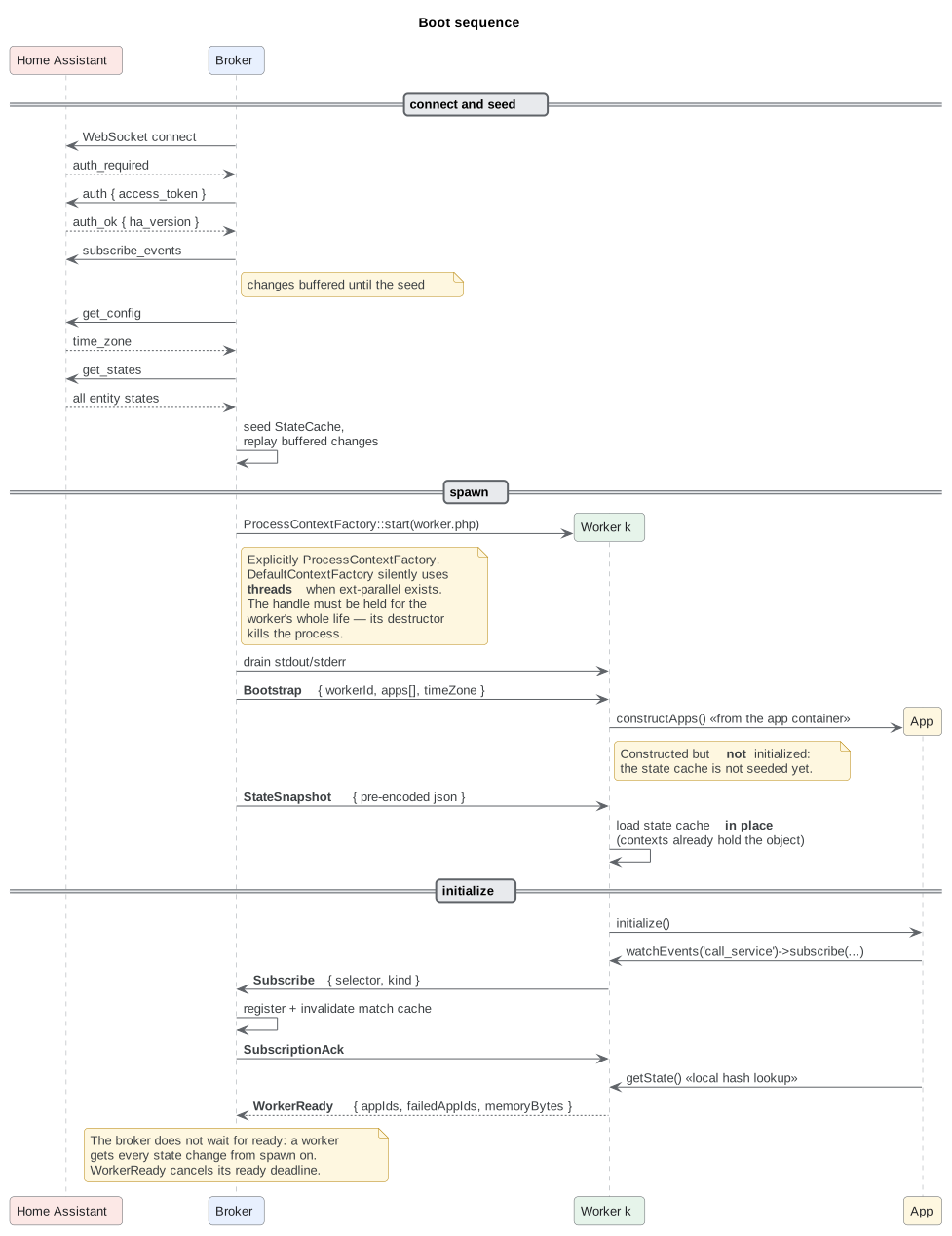
The ordering constraint worth internalising: apps are constructed on
Bootstrap but initialized only after StateSnapshot has populated the
state cache. Reading state inside initialize() is normal and must work.
RegistrySnapshot comes between the two, so the registry is loaded by then too.
The reader runs from before the first constructor, so a constructor may await a
ServiceCallRequest and get its answer. An app’s schedules and subscriptions
stay dormant until that app’s own initialize() returns; events matched in the
meantime are buffered under subscription_buffer and delivered in order once it
does.
The broker does not wait for WorkerReady: a worker gets every state change
from the moment it spawns, and WorkerReady only cancels its ready deadline.
Two amphp/parallel details that bite:
- Use
ProcessContextFactoryexplicitly.DefaultContextFactorysilently substitutes threads whenext-parallelis present — a different memory and failure model entirely. - The entrypoint file must
returna callable taking aChannel. Anything else fails with “did not return a callable function”. The Composer autoloader is already loaded (found by walking up), and the callable already runs inside a fiber, so it may await freely.
A state change
Section titled “A state change”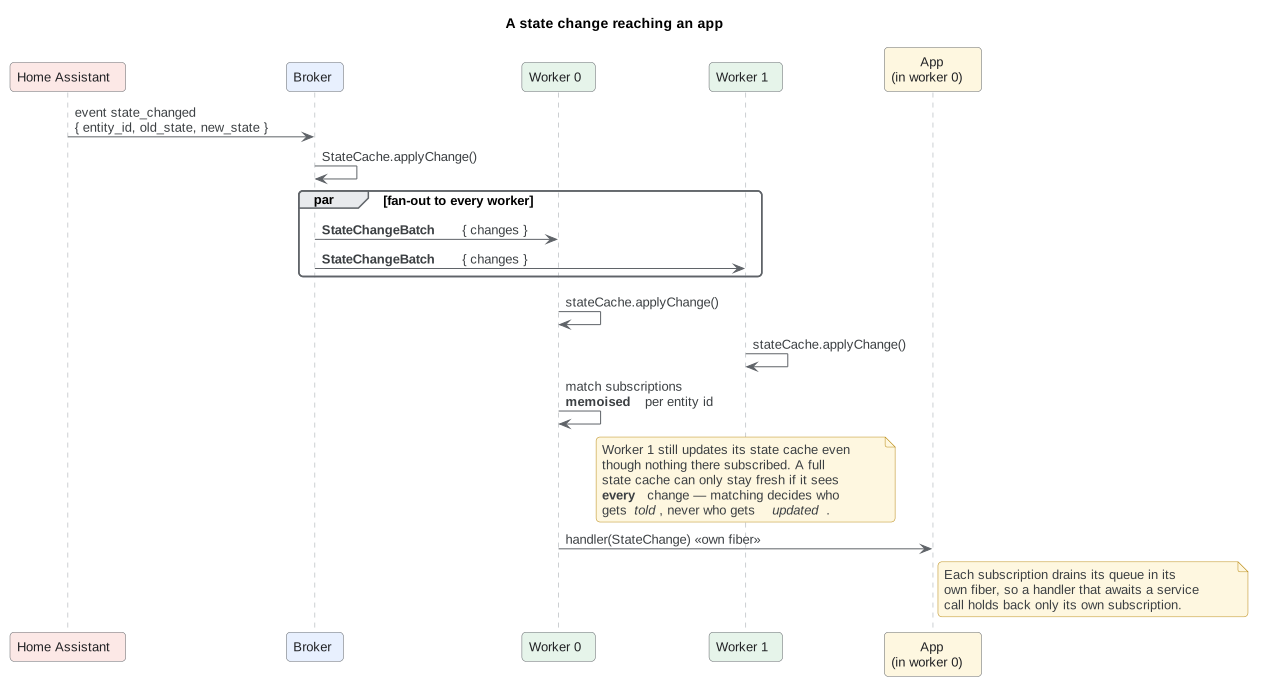
The broker sends every state change to every live worker, which applies it to its state cache and then matches it against its own subscriptions. There is no routing decision on the broker and no window in which a subscription exists in the worker but not yet in the broker.
Matching is memoised per entity ID in a SelectorIndex, the same one the
broker uses for events and topics. Entity IDs are a bounded, slow-changing set,
so fifty patterns across two thousand entities costs a few milliseconds once
and hash lookups thereafter. Exact-ID subscriptions — the overwhelming majority
— skip pattern matching entirely. The cache is also what makes pattern
subscriptions pick up entities created later: an unknown ID is evaluated on
first sight and remembered. Adding or removing a subscription clears it.
A worker with no subscriber still applies every change. That is the standing cost of the full-state-cache decision.
Each subscription has its own queue and one fiber that runs its handler, so one subscription handles its events one at a time while different subscriptions run concurrently. A handler that awaits a service call holds back only the later events of its own subscription.
A service call
Section titled “A service call”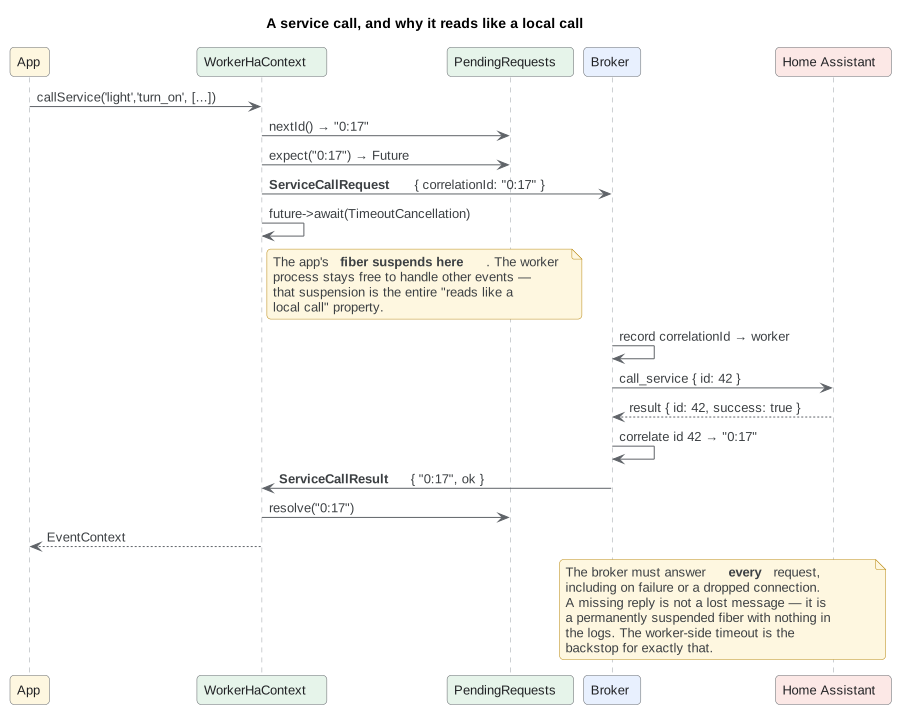
Two correlation maps, no cleverness: the worker maps correlationId → Future,
the broker maps correlationId → worker and haMessageId → correlationId. IDs
are {workerId}:{n}, unique across the daemon without coordination.
The fiber suspension in the middle is the whole “reads like a local call” property.
The failure mode to design against is a reply that never arrives, which leaves
that fiber suspended for the life of the process with nothing in the logs. So
the broker answers every request including failures, and the worker wraps every
await in a TimeoutCancellation as a backstop.
Every write to Home Assistant counts against one in-flight budget, HaCallSlots,
bounded by service_calls.max_in_flight and max_in_flight_per_worker: service
calls, fired events, history queries and registry edits alike. A fired event is a
write like a service call, so it shares the budget, the per-app call counts and
dry run; a burst of one can refuse the other. On the worker side, one
PendingRequests registry holds every correlated request.
A history query
Section titled “A history query”The same shape as a service call: one correlation ID from the same per-worker
sequence, one reply per request, the same worker-side timeout and the same
in-flight budget. The worker
turns HistoryQuery::lastFor() into a fixed window with its own clock before
sending, so the broker never sees a relative time. The reply carries only the
states; the worker already knows the entity and the window.
App-to-app messaging
Section titled “App-to-app messaging”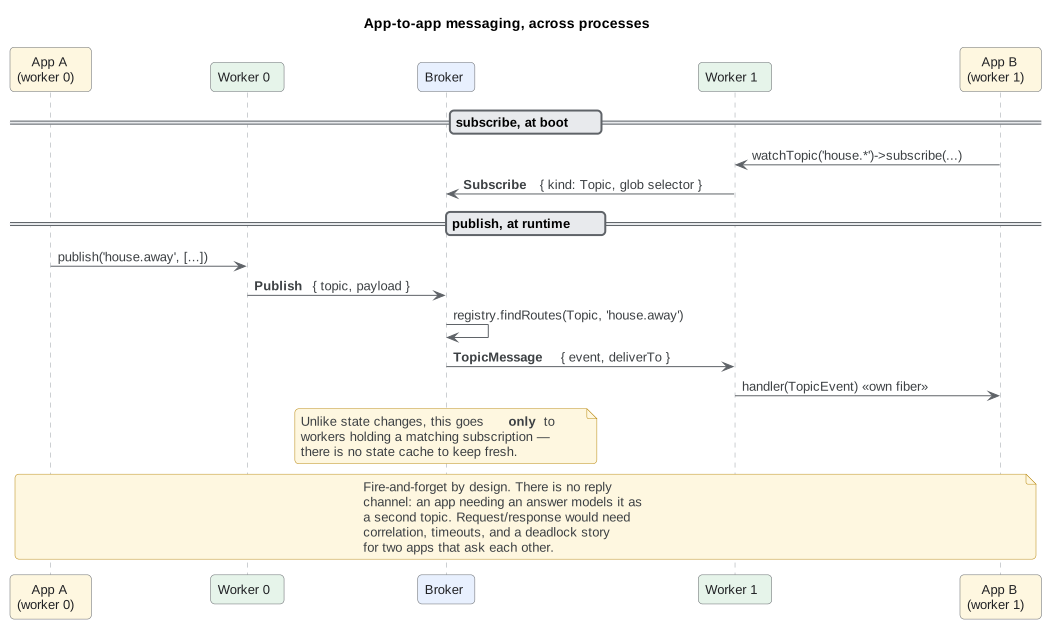
Named pub/sub, using the same selector machinery as entities — house.* works.
Unlike state changes, a topic message goes only to workers holding a matching
subscription; there is no state cache to keep fresh.
Fire-and-forget, with no reply channel. Request/response between apps was considered and rejected for now: it needs correlation IDs, timeouts, and a deadlock story for two apps that ask each other. An app needing an answer models it as a second topic. Adding it later is two more message types, not a redesign.
The broker holds the only MQTT connection, as it holds the only Home Assistant
one. stewart-php/mqtt provides it behind the MqttLink port; without
mqtt.url the broker uses a disabled link and workers are told
mqtt_enabled: false, so an app that asks for Mqtt is not started.
An app’s watchMessages('home/+/temp') is a Subscribe of kind mqtt with an
mqtt_filter selector. The broker counts subscribers per filter and sends
SUBSCRIBE to the server only for the first and UNSUBSCRIBE after the last.
Messages from the server are matched against the same registry and sent as
MqttMessageDelivery. Payloads are bytes, so they cross the IPC wire base64
encoded.
MqttPublish is fire-and-forget for the app. While the server is unreachable,
QoS 0 messages are dropped and logged; QoS 1 messages wait in a buffer of
mqtt.outbound_buffer, oldest dropped first, and are sent again after each
reconnect until the server acknowledges them. Sessions are clean: after a
reconnect the broker subscribes every active filter again.
Triggers
Section titled “Triggers”An app’s watchTrigger() is a SubscribeTrigger carrying the trigger configs
and variables. The broker keys it by a hash of the canonical JSON (map keys
sorted, lists in order) and counts subscribers per key, as it does for MQTT
filters: Home Assistant gets one subscribe_trigger for the first subscriber and
one unsubscribe_events after the last. When it fires, the broker sends
TriggerFired to every worker holding a subscription with that key.
Home Assistant’s subscription ids belong to one connection, so after every
connect the broker subscribes each live spec again, right after
subscribe_events and before seeding states. A trigger that fired during the
outage is not replayed, and fires that arrive while the state cache is rebuilt
are dropped, like events. If Home Assistant refuses a spec, at first or on a
later reconnect, every subscriber gets SubscriptionAck(false, reason) and is
removed; the connection itself carries on.
Shutdown
Section titled “Shutdown”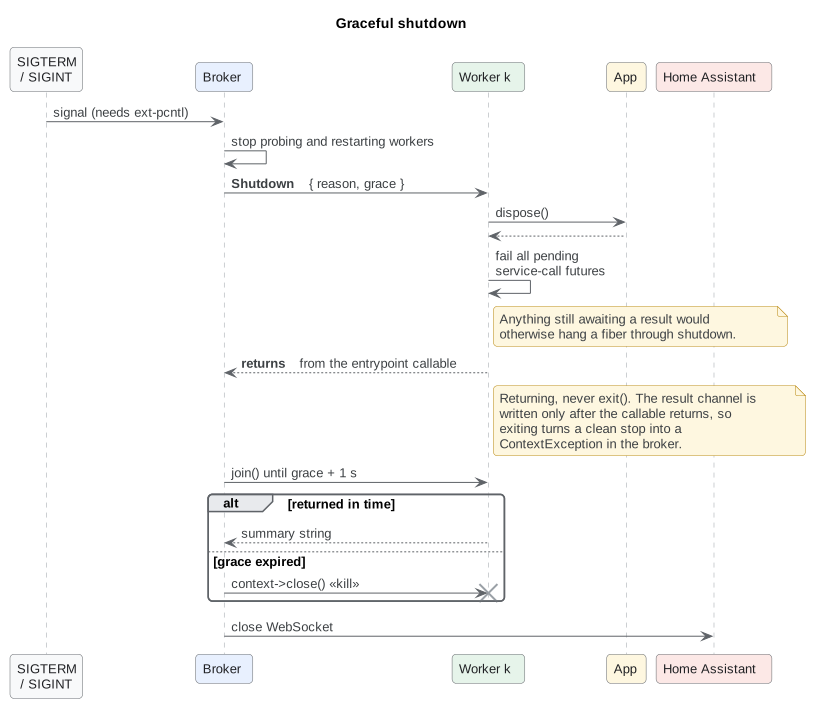
SIGTERM or SIGINT → stop probing and restarting workers → Shutdown to each worker →
dispose() → the worker returns → join() with a grace period →
close() only as the force-kill, because ProcessContext::close() sends a kill
signal outright.
Signal handling requires ext-pcntl. Without it Revolt’s onSignal() throws
and shutdown cannot be graceful at all, which is why make doctor checks for
it.
Backpressure
Section titled “Backpressure”Each WorkerHandle holds a bounded outbound buffer (1000 by default,
worker_event_buffer in stewart.yaml). Topic messages and Home Assistant
events share it; when it fills, the oldest of them is dropped, a warning
names the worker and the drop count, and the count travels in the worker’s
outbox status. Every other message is kept, except that an unanswered probe is
replaced by the next one rather than queued behind it. State changes are not counted against the
buffer: they coalesce per entity instead, so a slow worker sees fewer of them
but never loses the latest.
A queued RegistrySnapshot is replaced by a newer one, like an unanswered
probe, so a slow worker gets only the latest registry.
Coalescing keeps the first queued change of an entity where it is and merges
every later one into a single change at the tail, from the state the first one
reached to the latest. on → off → on therefore still arrives as two edges, and
the merged change never overtakes an event queued before it. Consecutive queued
state changes leave as one StateChangeBatch of at most worker_state_batch
(256 by default).
Inside the worker, each subscription queues up to subscription_buffer events
(100 by default) while its handler is busy. When a state-change queue is full, it
first drops the oldest change that a newer change of the same entity supersedes,
and the newer one starts from the dropped one’s state. A quiet entity’s only
change therefore survives a chatty neighbour. If no entity has two queued
changes, and for every other kind of event, the oldest is dropped. A burst of
state changes, one StateChangeBatch or a resync, is queued whole: older queued
events make room for it. Drops are counted per app and logged as a sampled
warning.
Dropping oldest rather than newest is the right way round for automations: a stale state change is the least valuable thing in the queue. Blocking instead would let one slow app halt every other automation in the house, which defeats the point of the isolation. Unbounded buffering is an OOM waiting for a slow app.
Reconnect
Section titled “Reconnect”The connection drops, HaConnection fires its disconnect hook, and the broker
retries forever with capped backoff. A worker that dies meanwhile is restarted
on its usual backoff. It is bootstrapped with the last snapshot, told
HaConnectionLost straight after, and resynced with everyone else.
Each attempt closes any half-open socket, connects, subscribes first, then
calls get_states. Changes arriving between the two are buffered by entity id
and drained onto the cache straight after the seed. Seeding before subscribing
would lose every change in that window permanently.
Every live worker hears HaConnectionLost when the connection drops. From
then on isConnected() is false and callService() fails at once as
Unreachable. Schedules keep running.
Each attempt also reads the five registries after get_states. The seed, the
re-encode and the broadcast contain no suspension point, so no worker can see a
half-rebuilt cache. Every live worker then gets one RegistrySnapshot and one
StateResynced, in that order, so reconstructed changes match entity filters
against the current registry. Each one compares the new snapshot with its state cache, swaps it
in, and queues one reconstructed StateChange (origin: Resync) per entity
that differs, including entities that appeared or disappeared. Then it
dispatches ConnectionRestored to the apps that listen. A flap during the
outage shows as one edge, because only the two ends are known.
Failure modes
Section titled “Failure modes”| What happens | How it surfaces | What the broker does |
|---|---|---|
Worker segfaults or is kill -9’d |
receive() throws ContextException |
Drops its subscriptions, then respawns it after a backoff |
| A worker keeps dying | restart_attempts spent inside restart_window |
Quarantines it and logs at error, naming the automations now down |
| Worker stops responding | Pong lag climbs, or nonces go unanswered |
Warns, naming the worker and its apps — usually blocking code |
App throws in initialize() |
AppFailed with phase Initialize |
App is dropped and its subscriptions cancelled |
| App throws in a handler | AppFailed with phase Handler |
Logged; the app keeps running |
| An event or topic subscription the broker cannot route | SubscriptionAck { accepted: false } |
Worker logs an error rather than receiving nothing forever |
| Home Assistant restarts | HaClientError::ConnectionDropped |
Sends HaConnectionLost, reconnects with capped backoff, rebuilds state, sends StateResynced |
| The store stops answering | A worker’s call times out or finds it unreachable | Nothing: that worker fails store calls at once for persistence.recovery_interval, then tries again; its next Pong reports the store down |
| A frame cannot be decoded | TransportError::UndecodableFrame |
The reader logs the tag and drops the frame; an undecodable Bootstrap stops the worker |
| Broker and worker disagree on the protocol | TransportError::ProtocolMismatch on Bootstrap |
The worker stops; the restart budget quarantines it if it keeps happening |
| Home Assistant rejects the token | HaClientError::TokenRejected |
Fatal: stops every worker cleanly and exits non-zero |
| The token’s user is not an administrator | HaClientError::AdministratorRequired on subscribe_events |
Fatal the same way; retrying cannot grant the privilege |
Testing it
Section titled “Testing it”packages/runtime/tests/Integration/Protocol/WorkerProtocolTest.php boots a
worker in-process over an in-memory transport pair and drives the whole protocol
from the test, standing in for the broker. Frames still go through the codecs. It
runs with make test-integration and needs neither Home Assistant nor Valkey.
This is the test that earns its keep: the entrypoint contract, the initialize-after-snapshot ordering, selector serialization, service-call correlation and clean shutdown are all invisible to testing a single class.
make test-process runs packages/runtime/tests/Process/WorkerProcessSmokeTest.php: a real
worker process over a real pipe, and a store in Valkey that outlives it.